

 Español
Call us
+86-19818583496
+86-0577-68586867

Our team is proud to offer on time guarantee and product guarantee to customer satisfaction.
Read MoreA pressroom operator running a four-color job at full speed doesn't usually notice a bearing problem until the registration starts drifting or a faint banding pattern shows up on sheet after sheet. By the time that's visible on the printed output, the underlying cylinder bearing wear has usually been progressing for weeks — quietly changing the running clearance of the impression or blanket cylinder long before anyone pulled a maintenance log.
Most cylinder bearing wear doesn't come from a single dramatic event. It builds from a combination of factors that are individually minor: slightly inconsistent lubrication intervals, a press running above its rated speed for a stretch of high-volume jobs, or contamination working its way past a seal that's a generation or two past its service life. Cylinder bearings on presses from Heidelberg and Manroland lines are held to running-accuracy tolerances that are closer to machine-tool spec than to general industrial bearing spec, so even a small amount of radial play translates directly into print quality loss rather than staying hidden inside the mechanism.
Preload also plays a bigger role than most operators expect. Taper roller and needle bearing arrangements used to support printing cylinders rely on a specific preload to keep running clearance near zero; once cylinder bearing wear progresses far enough to reduce that preload, the cylinder starts to move under load in ways the original mold and blanket packing weren't set up to handle. That's often the point where a press that was producing clean sheets six months ago starts needing packing adjustments every shift just to hold the same output.
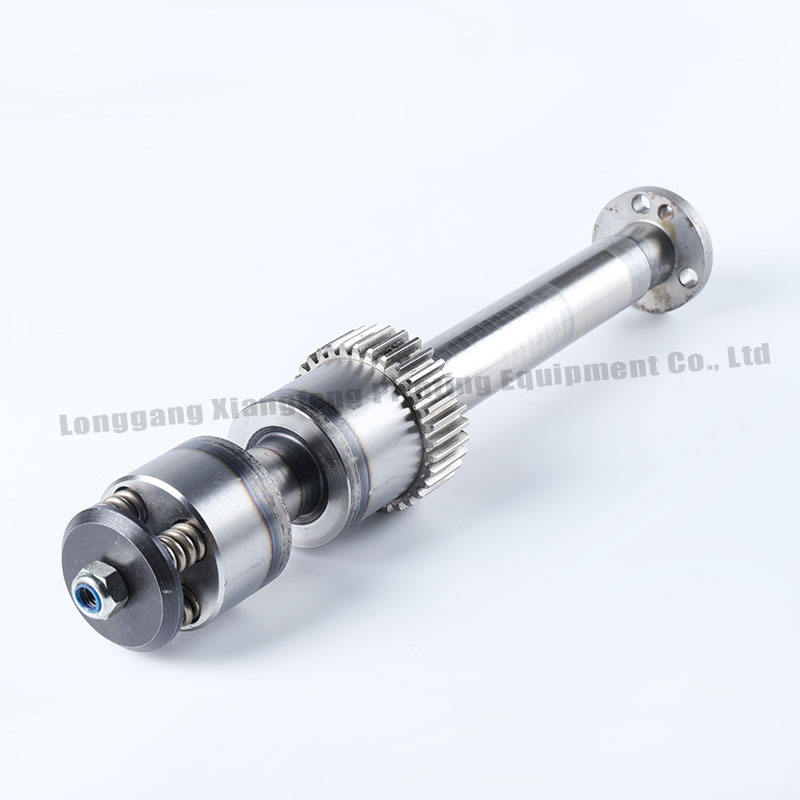
A printer bearing rarely goes from fine to seized without warning. Low-frequency vibration near the cylinder ends, a faint whine that changes pitch with press speed, or heat building up around the bearing housing after a run are the more common early signals. None of them are dramatic enough on their own to stop a job mid-run, which is exactly why cylinder bearing wear tends to get caught late — the symptoms look like they could be caused by a dozen other things, from blanket wear to ink tack issues.
Tracking registration drift against maintenance history is a more reliable diagnostic than any single symptom. If registration on a given unit keeps requiring correction at a shorter interval each week, and packing thickness hasn't changed, the running clearance inside the printer cylinder support is the more likely explanation than anything upstream in the ink or dampening system.
Different presses and different cylinder positions call for different bearing arrangements, and the choice affects both service life and how tolerant the bearing is of the speed and load a given press runs.
|
Bearing Type |
Running Accuracy |
Preload Behavior |
Typical Position |
Relative Service Life Under Heavy Use |
|
Needle bearing |
High |
Fixed clearance, sensitive to contamination |
Plate/blanket cylinder ends on some German-built presses |
Moderate — shorter if lubrication intervals slip |
|
Taper roller bearing (back-to-back) |
High, tolerance class up to P4 |
Adjustable preload via spacer ring |
Impression and transfer cylinders |
Longer — tolerates load variation better |
|
Standard deep-groove ball bearing |
Moderate |
Not adjustable |
Lower-load auxiliary rollers, feeders |
Shorter under continuous high-speed cylinder duty |
For the impression and transfer cylinders that see the highest running load, taper roller arrangements generally hold tolerance longer than standard ball bearings — which is part of why most printing machine bearing replacements for those positions specify taper roller rather than a general-purpose substitute.
A replacement printer bearing that's dimensionally close but not matched to the original preload spec can shorten service life even when it fits the housing. Bearings sourced against the original part number — rather than a generic bore/OD match — carry the correct internal clearance class for the cylinder position they're going into, which matters more for cylinder bearing wear prevention than the bearing brand stamped on the outer ring.
Xiangfeng Printing Equipment, based in Longgang City, Wenzhou, and operating since 2011, supplies both new-manufactured and original second-hand bearings for Heidelberg and Manroland cylinder positions, with pre-production samples and final inspection run before parts ship — a step that matters more for a rotating, tolerance-critical component like a cylinder bearing than it would for a static bracket or cover.

+86-19818583496
+86-0577-68586867


No.777 Haixi rode, Longgang City, Wenzhou City, Zhejiang, China
On weekdays, we will reply to you or call us within 12 hours of receiving the inquiry.
Copyright © Xiangfeng Printing Equipment Co., Ltd. All Rights Reserved.

Printing Machine Accessries Factory
Contact Us