

 Español
Call us
+86-19818583496
+86-0577-68586867

Our team is proud to offer on time guarantee and product guarantee to customer satisfaction.
Read MoreA press running fine for a decade can suddenly turn a motor replacement into a multi-week sourcing problem — not because the part is rare, but because the buyer assumed one Heidelberg press drive motor could stand in for another as long as the shaft size and voltage matched. On a modern offset press, that assumption often doesn't hold anymore, and the reason has more to do with how the press synchronizes its cylinders than with the motor itself.
Older press generations ran on a single central drive shaft: one main motor turned a long mechanical train, and every printing unit's cylinders stayed in registration because they were all physically geared to that same shaft. A Heidelberg press drive motor in that architecture only had to deliver consistent torque — the mechanical linkage handled synchronization on its own.
Newer press platforms have largely moved away from that layout toward individual drives, where each printing unit runs on its own motor rather than sharing a common shaft. Registration between units is now held electronically, through motor encoder feedback and the press's control system, instead of through a gear train. That shift changes what a Heidelberg press drive motor actually has to do: it's no longer just a torque source, it's one node in a synchronization loop that has to match timing with every other unit on the press to a tolerance the mechanical era never had to think about.
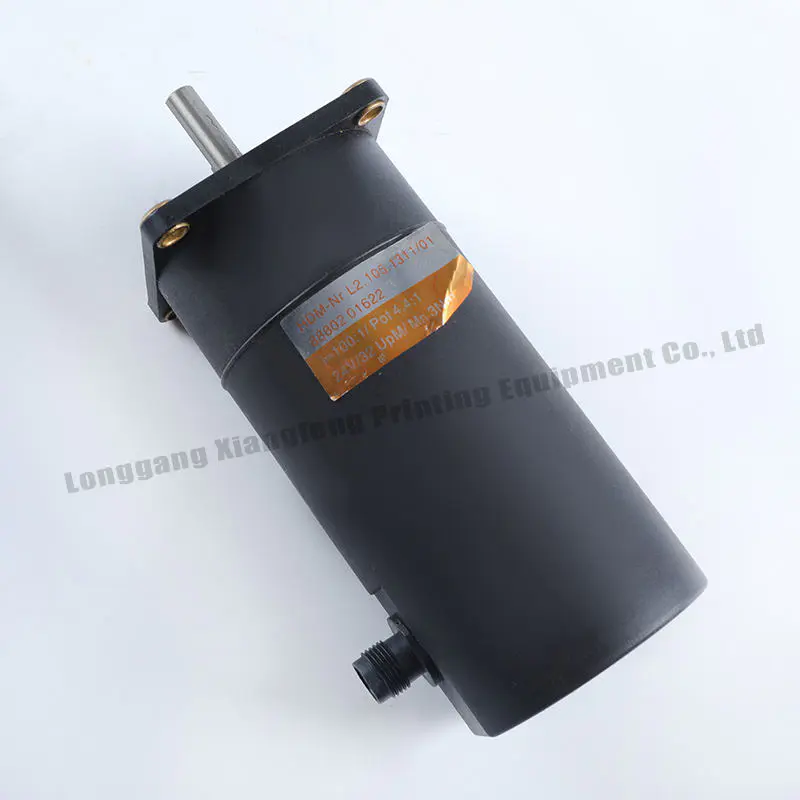
For a buyer replacing a printing machine motor on an older single-shaft press, the sourcing question is mostly mechanical — output shaft dimensions, mounting bolt pattern, rated torque and speed curve. Get those right and the part functions.
For a Heidelberg press drive motor on an individually driven unit, the electronic side matters just as much as the mechanical fit. Encoder resolution — pulses per revolution — has to match what the press's control system expects, and the feedback signal type has to be compatible with the drive controller reading it. A motor that's mechanically identical but carries an encoder with different resolution will either fail to register with the control system at all, or worse, run without throwing an error while producing subtle timing drift between units that shows up later as misregistration nobody can immediately trace back to the motor.
This is part of why buyers sometimes report that a motor "matched the spec sheet" but still didn't restore the press to its prior performance — the spec sheet they were comparing against covered torque and dimensions, not the encoder and feedback characteristics that individual-drive architecture actually depends on.
Presses running individual drive technology tend to be newer, which means their control systems and encoder standards are still relatively current — sourcing a Heidelberg press drive motor is more about finding the correct part number than solving a compatibility puzzle. The harder cases usually come from the transition generation: presses built during the shift toward individual drives, where encoder standards varied more between manufacturers and even between press models from the same manufacturer, and where original motor part numbers have started aging out of easy availability.
For that transition-generation equipment, a buyer sourcing a replacement printing machine motor benefits from confirming three things before ordering rather than after installation fails: the original part number rather than a generic spec match, the encoder's pulse count and output signal type, and whether the press's drive controller firmware version affects which replacement motors it will recognize. That third point catches people off guard most often — a mechanically and electronically correct motor can still be rejected by a control system running an older firmware version that wasn't updated to recognize a newer motor's identification signal.
The broader trend toward individual drive systems has made press motors more capable — faster makeready, tighter registration control, less mechanical wear from long drive trains — but it has also made "replacement motor" a more specific sourcing problem than it used to be, one where matching the original electronics matters as much as matching the shaft.

+86-19818583496
+86-0577-68586867


No.777 Haixi rode, Longgang City, Wenzhou City, Zhejiang, China
On weekdays, we will reply to you or call us within 12 hours of receiving the inquiry.
Copyright © Xiangfeng Printing Equipment Co., Ltd. All Rights Reserved.

Printing Machine Accessries Factory
Contact Us