

 Español
Call us
+86-19818583496
+86-0577-68586867

Our team is proud to offer on time guarantee and product guarantee to customer satisfaction.
Read MoreA pressroom running a packaging job with tight Pantone tolerances doesn't usually think to check an Offset Press Ink Nozzle when color starts drifting off spec mid-run. The instinct is to blame the ink batch or the fountain solution balance. More often, the actual cause is smaller and less obvious: an ink nozzle orifice that's worn just enough to change flow rate, even though the part still looks intact to the naked eye.
An ink nozzle orifice is machined to a tolerance measured in microns, because the flow rate through that opening is what determines how much ink lands on the plate at a given key setting. Pigment particles in most offset inks are abrasive at a microscopic level — not enough to damage the Offset Press Ink Nozzle in a single run, but enough that continuous high-speed operation gradually erodes the orifice edge. As the edge rounds off, flow rate increases slightly at the same key setting, and the operator ends up compensating with lower ink key values without ever identifying why the same setting that used to produce correct density now runs too heavy.
This kind of gradual drift is harder to catch than an outright nozzle blockage, because nothing stops working — the press keeps printing, and the color shift can look like an ink or dampening issue for weeks before anyone traces it back to the Offset Press Ink Nozzle itself. Presses running high-volume packaging or commercial work, where the same job repeats over many shifts, tend to see this wear pattern show up faster than lower-volume sheetfed work.
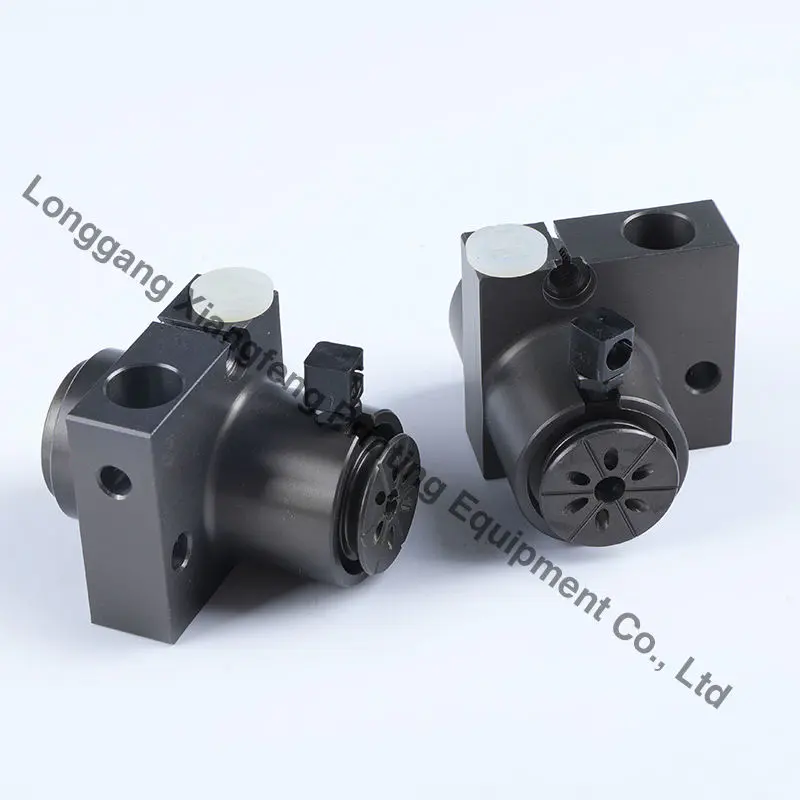
Nozzle material grade is what determines how long that orifice tolerance actually holds under continuous pigment exposure. Many Offset Press Ink Nozzle bodies are machined from 303 or 316 stainless steel, with 316 offering better resistance to the corrosive additives found in some fountain solutions and UV-curable ink formulations. The difference matters more at the orifice itself than anywhere else on the part — a nozzle body can be dimensionally sound everywhere except at the one point where ink actually passes through under pressure, and that's where a lower-grade material shows wear.
Some Offset Press Ink Nozzle designs use a hardened insert or liner at the orifice rather than machining the entire body from a harder alloy, which keeps material cost down while still protecting the one surface that actually wears. For buyers comparing nozzle suppliers, asking whether the orifice is a hardened insert or solid-body construction is a more useful question than asking about the base material alone, since the answer determines how the part actually behaves after a few thousand hours of run time rather than how it looks on a spec sheet.
The broader move toward UV and LED-curable inks in commercial and packaging print — driven by faster drying times and lower VOC output — has changed what Offset Press Ink Nozzle material actually needs to withstand. UV-curable formulations tend to be more chemically aggressive toward standard stainless grades than conventional oil-based inks, particularly around seals and orifice edges, which means a nozzle spec that held up fine on a press running traditional ink can wear noticeably faster once a shop switches part of its work to UV or hybrid curing.
Packaging printers moving toward water-based and low-migration ink systems for food-contact applications face a related shift: some water-based formulations carry different pigment dispersion characteristics that change abrasion patterns at the orifice compared to oil-based ink. An Offset Press Ink Nozzle spec chosen years ago for one ink chemistry doesn't automatically carry over cleanly when a shop's ink mix changes, even if the press itself hasn't.
Xiangfeng Printing Equipment, supplying Heidelberg and Manroland nozzle parts out of Longgang City, Wenzhou since 2011, Offset Press Ink Nozzle orifices against original part specifications rather than a generic bore match — a distinction that matters more for a component whose failure shows up as a color problem than a mechanical one, and one that's easy to overlook until a run has already gone off spec.

+86-19818583496
+86-0577-68586867


No.777 Haixi rode, Longgang City, Wenzhou City, Zhejiang, China
On weekdays, we will reply to you or call us within 12 hours of receiving the inquiry.
Copyright © Xiangfeng Printing Equipment Co., Ltd. All Rights Reserved.

Printing Machine Accessries Factory
Contact Us