

 Español
Call us
+86-19818583496
+86-0577-68586867

Our team is proud to offer on time guarantee and product guarantee to customer satisfaction.
Read MoreA control cabinet running four printing units, several servo drives, and a rack of power electronics generates more heat in an afternoon than most operators think about — until the cabinet trips on a thermal fault mid-run. The part usually blamed is the drive or the power supply. More often, it's an Offset Press Motor Cooling Fan that's been running past its rated service life on a motor winding grade that was never matched to the cabinet's actual heat load.
Buyers comparing replacement fans tend to look first at CFM rating and physical dimensions, since those are the specs that determine whether the part fits. But two fans with identical airflow numbers can have very different service lives inside a press cabinet, because the materials behind that airflow rating are rarely equivalent. A motor Offset Press Motor Cooling Fan running continuously near drive electronics needs a winding insulation class rated for sustained heat exposure, not just a peak temperature it can survive for a few minutes.
Insulation class is graded by the maximum continuous operating temperature the winding can tolerate without breaking down:
An Offset Press Motor Cooling Fan built to Class B insulation and installed in a position that was originally spec'd for Class F will often run within its rated life for months before failing early — which is part of why an Offset Press Motor Cooling Fan that "matches the model number" doesn't always match the original part's actual duty rating.
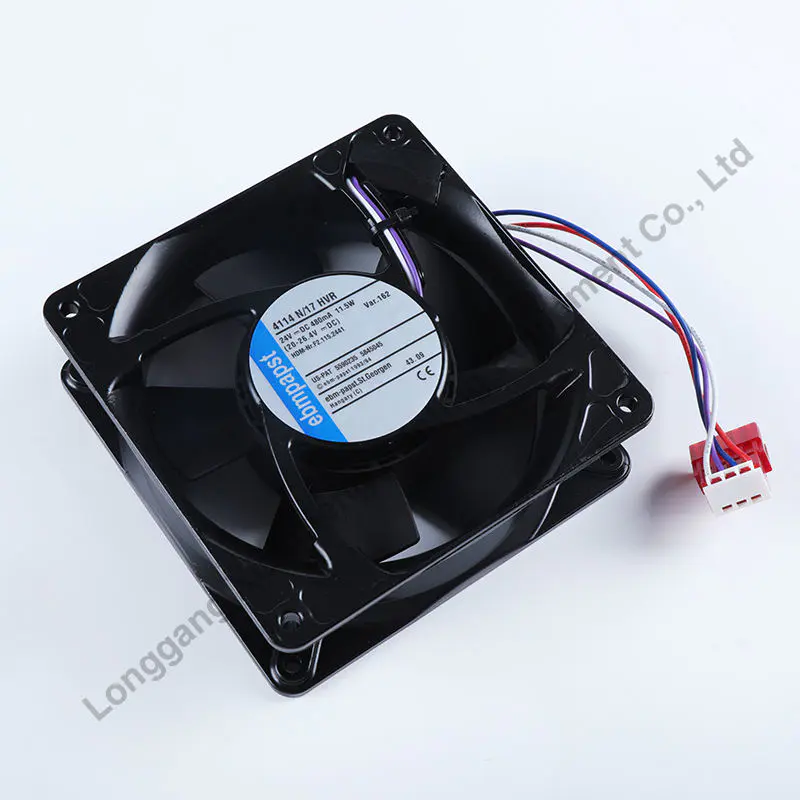
Motor grade isn't the only material decision that shows up in how long an Offset Press Motor Cooling Fan lasts inside a press. Blade material matters almost as much, since the blade is what's directly exposed to airflow temperature, dust from paper stock, and — on some cabinet positions — light exposure to solvent vapor from cleaning agents used nearby.
Glass-fiber reinforced PBT or nylon blades, molded to a flame-retardant rating such as UL94-V0, hold their shape better under sustained heat than unreinforced plastic, which tends to soften slightly at elevated cabinet temperatures and lose blade balance over time — a small imbalance that shows up later as bearing noise even though the bearing itself isn't the root cause. Housing material follows a similar logic: a metal frame dissipates heat away from the motor housing faster than a plastic frame, which matters more in an Offset Press Motor Cooling Fan mounted directly against a warm cabinet wall than in one with open airflow on all sides.
Bearing type inside the fan motor is the third material factor worth checking before ordering a replacement. Sleeve-bearing fans are quieter at low cost but wear faster under continuous duty; ball-bearing motors cost more but hold consistent performance through the kind of multi-shift running schedule a production pressroom actually puts an Offset Press Motor Cooling Fan through.
The safest way to avoid an early failure is sourcing a replacement against the original part number and its documented insulation class, rather than matching only on physical size and voltage. Xiangfeng Printing Equipment, operating out of Longgang City, Wenzhou since 2011, supplies both new-manufactured and original second-hand printer fan units for Heidelberg and Manroland cabinet and motor cooling positions, sourced against original specifications rather than a generic size match — which matters for a component whose failure mode is often invisible until it takes a drive module down with it.

+86-19818583496
+86-0577-68586867


No.777 Haixi rode, Longgang City, Wenzhou City, Zhejiang, China
On weekdays, we will reply to you or call us within 12 hours of receiving the inquiry.
Copyright © Xiangfeng Printing Equipment Co., Ltd. All Rights Reserved.

Printing Machine Accessries Factory
Contact Us