

 Español
Call us
+86-19818583496
+86-0577-68586867

Our team is proud to offer on time guarantee and product guarantee to customer satisfaction.
Read MoreA Print Head Solenoid Valve works through a short chain of events: a signal energizes a coil, the coil moves a plunger, and compressed air is switched on or off at a set moment. The chain repeats for as long as a press runs, and each link wears in its own way. Xiangfeng Printing Equipment Co., Ltd. has supplied press parts from Wenzhou, Zhejiang since 2011, and its Heidelberg accessories range includes solenoid valves carrying Heidelberg part numbers.
Much of the movement inside a Print Head Solenoid Valve comes from a plunger sliding in a tube with very little clearance. Compressed air on a press carries traces of oil, water vapour and fine dust from the compressor and the pipework, and these collect in that clearance. The plunger then moves slowly or stops halfway, which a press operator sees as a sluggish action or an air function that arrives late. A Print Head Solenoid Valve that sticks in this way often tests normal on the bench with clean air and fails again after a few days in service, so the cause lies in the air supply as much as in the valve.
Seals are the second weak point in a Print Head Solenoid Valve. A rubber seat that hardens or swells with oil mist no longer closes tightly, and air leaks past it even when the coil is off. Xiangfeng lists valves in three quality tiers, original new, original used and Made in China, so a seal that has aged in a used valve can be weighed against a new one before a purchase is made.
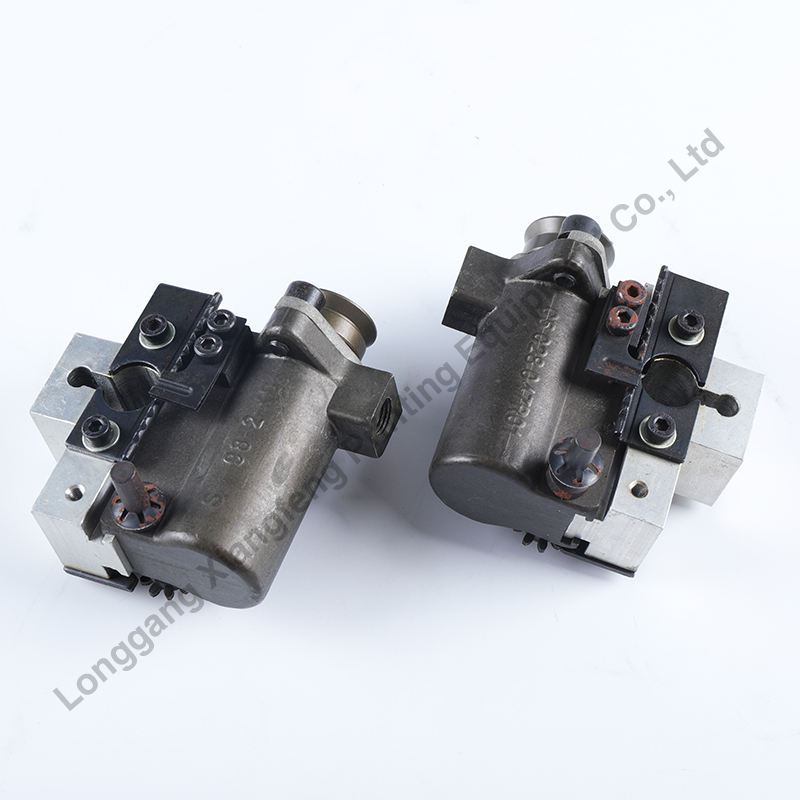
A coil that has overheated gives a different set of signs. The valve stays silent when the signal arrives, or it clicks and then drops out once warm. Heat usually comes from a coil held on for long periods, from a supply voltage that does not match the coil, or from a plunger that is stuck and keeps the coil under load. Telling the two groups apart saves time:
The same fault list applies to each Print Head Solenoid Valve on a press, which is why a spare tends to be ordered by part number and not by looks.
Solenoid valves from different press generations can look alike on the outside and differ in coil voltage, port layout and the internal seat. The Heidelberg numbers on the Xiangfeng listing run across several families, including M2.184, 61.184, F4.335, G4.335, R2.335, G2.335 and G2.013 entries, with suffixes such as /05 and /01 that mark versions of the same base number. A valve ordered against the full number, suffix included, is matched to the version the press was built with.
Where a number is no longer supplied, Xiangfeng develops and produces parts from customer drawings or samples, using an in-house R&D team and a CNC processing workshop. For a Print Head Solenoid Valve, the body and the plunger bore are the machined parts, so a sample sent in can be measured and reproduced instead of being replaced by a near fit.
A valve is easier to trust once its action has been seen. Xiangfeng provides a test video before shipment, so the switching of a Print Head Solenoid Valve can be viewed before it is packed and sent. The workshop is close to Ningbo Port, which keeps the route to export markets in Europe, America and Japan short, and inquiries on weekdays receive a reply or a call within 12 hours.
Valve life follows the quality of the air it passes. A drain on the compressed-air line, a working filter and dry air extend the time a Print Head Solenoid Valve keeps switching cleanly, and a plunger that has been freed with cleaning will often work again for a while. Replacement is the better course once the seat is worn or the coil has burned, since a new coil on a scored valve body shifts the fault to another part of the chain.

+86-19818583496
+86-0577-68586867


No.777 Haixi rode, Longgang City, Wenzhou City, Zhejiang, China
On weekdays, we will reply to you or call us within 12 hours of receiving the inquiry.
Copyright © Xiangfeng Printing Equipment Co., Ltd. All Rights Reserved.

Printing Machine Accessries Factory
Contact Us