

 Español

Call us
+86-19818583496
+86-0577-68586867

Our team is proud to offer on time guarantee and product guarantee to customer satisfaction.
Read MorePrinting Machine Bearing duty involves two distinct types of movement: continuous rotation and short back-and-forth oscillation. Although both occur throughout a printing press, they create different operating conditions for the bearings. Cylinders and drive shafts rely on continuous rotation, while pivots, levers, cams and gripper mechanisms repeatedly move through limited angles. These positions may experience wear even when their operating speeds are relatively low, making motion type an important factor in bearing selection and maintenance.
In a continuously rotating bearing, each rolling element passes through the loaded zone once per revolution. As the shaft turns, the contact area moves around the raceway, and lubricant is carried through the rolling contacts. A properly lubricated Roller Bearing or ball bearing operating under a steady load can therefore distribute contact over a larger portion of its raceway.
This is the operating condition commonly associated with cylinder supports, drive shafts and roller ends. Speed, applied load and lubrication intervals all influence service life, although actual performance also depends on alignment, operating temperature and contamination. Many conventional Printing Machine Bearing selection and rating calculations focus on this type of movement, but they do not fully describe every bearing position inside a press.
A bearing that swings through a limited angle repeatedly reverses direction instead of completing full revolutions. Its rolling elements travel over a short section of the raceway, leaving the same contact areas exposed to repeated movement. The lubricant may not circulate through the contact as effectively as it does during continuous rotation.
Small oscillations and vibration can also produce surface damage known as false brinelling. This condition is associated with repeated small movements at the contact surfaces and can leave shallow marks or a rough feel, even when the bearing has not operated at normal rotational speed.
Printing presses have several mechanisms with this type of movement. Feeder pivots, sheet gripper bars, swing arms and clamp mechanisms all operate through limited angles. Xiangfeng's product range includes feeders and plate clamps alongside printing machine bearings. A Printer Bearing used in these mechanisms therefore faces different operating conditions from one supporting a continuously rotating cylinder, even if their dimensions are similar. Each Printing Machine Bearing needs to be considered according to its actual position and movement.
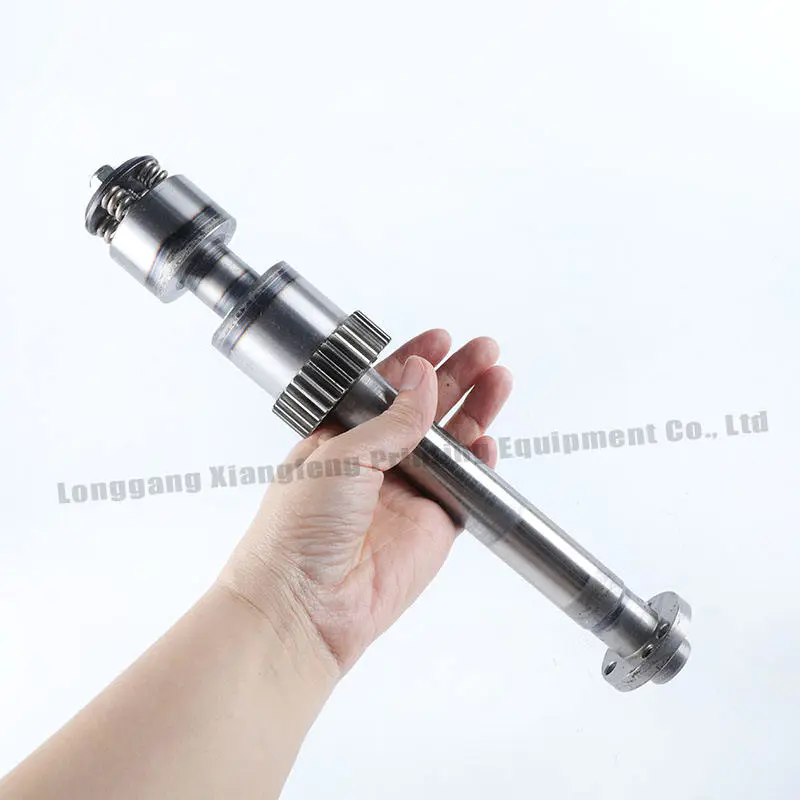
Lubrication requirements also change with the type of movement. Rotating bearings are commonly maintained according to operating speed, temperature and lubrication intervals. For oscillating applications, grease retention and protection of the contact area become particularly important. Maintenance schedules should account for operating cycles and working hours rather than relying on temperature alone.
Contamination is another concern throughout a printing press. Paper dust, ink mist and cleaning solvents can reach bearing positions, while certain solvents may affect seal materials. A sealed Printer Bearing helps retain grease and limit the entry of contaminants, but seal condition still needs to be checked during maintenance. In oscillating applications, the limited movement may leave contaminants around the seal lip instead of distributing or displacing them through continuous rotation.
When replacing a Printing Machine Bearing, technicians need to check more than bore diameter, outside diameter and width. Load direction, movement type, lubrication conditions and sealing requirements also affect whether a replacement is suitable. Recording these details for each installation position makes future maintenance and spare-part selection more consistent.
A Roller Bearing with line contact can support relatively high loads within a compact space, while ball bearings are commonly used where load and operating requirements suit their contact geometry. Needle and other roller bearing arrangements may also be considered for applications with limited installation space and specific load requirements. The final choice depends on the actual bearing arrangement, not simply whether the mechanism rotates or swings.
Spare parts lists for printing presses commonly identify bearings by size and part number. Adding a motion-type field, such as continuous rotation or oscillating movement, provides useful maintenance information for every Printing Machine Bearing in the equipment. It also helps technicians distinguish inspection requirements: rotating positions can be checked for noise, temperature and vibration, while oscillating positions may require closer attention to surface condition, looseness and mechanical play.
Xiangfeng Printing Equipment, based in Wenzhou, supplies printing machine accessories for Heidelberg, Manroland, KBA, Komori and Ryobi equipment. Its product range includes original new parts, original second-hand parts and developed parts for these brands. Recording the bearing's position and operating movement alongside its part number gives buyers and maintenance teams a clearer basis for replacement orders across different press models.

+86-19818583496
+86-0577-68586867


No.777 Haixi rode, Longgang City, Wenzhou City, Zhejiang, China
On weekdays, we will reply to you or call us within 12 hours of receiving the inquiry.
Copyright © Xiangfeng Printing Equipment Co., Ltd. All Rights Reserved.

Printing Machine Accessries Factory
Contact Us