

 Español
Call us
+86-19818583496
+86-0577-68586867

Our team is proud to offer on time guarantee and product guarantee to customer satisfaction.
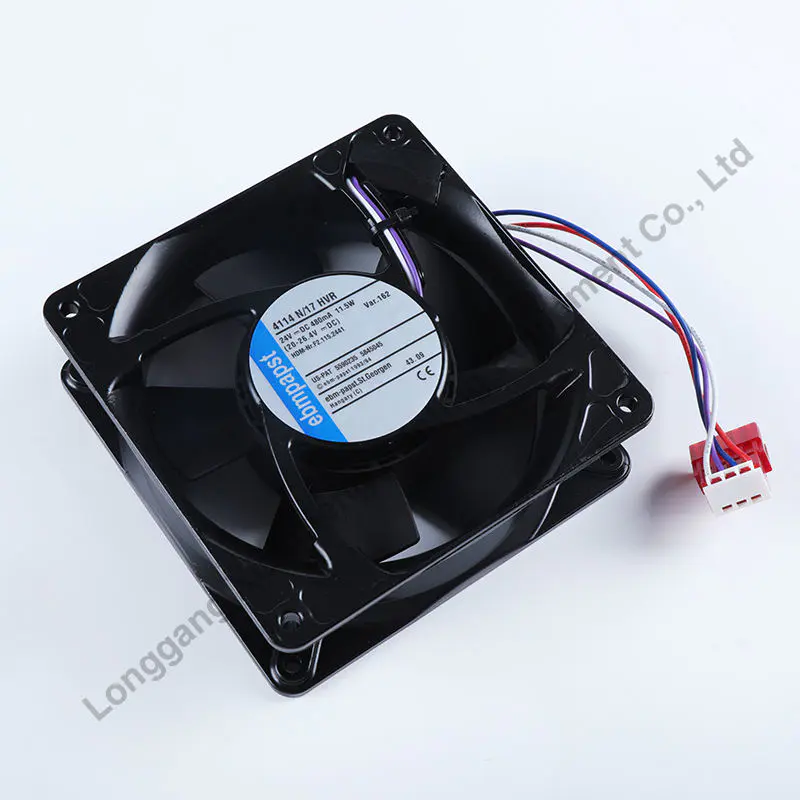
Read MoreA Hotend Cooling Fan rated for continuous duty on a commercial printing line faces a different failure mode than the same component running in a short-cycle application, and buyers sourcing replacement units for Heidelberg-class presses often discover this only after an early field failure.
Two fans with identical CFM ratings can differ substantially in field life depending on whether the motor uses sleeve bearings or ball bearings. A Hotend Cooling Fan built with dual ball bearings tolerates continuous operation and higher ambient heat near the press unit better than a sleeve-bearing equivalent, which tends to degrade faster once lubricant thins out under sustained heat. Buyers replacing OEM fans on Heidelberg or Manroland units should confirm bearing type specifically, since spec sheets often list only airflow and noise figures without stating which bearing design was used to achieve them.
Plastic blade assemblies molded from standard resin can warp slightly after repeated heating and cooling near a press's ink or drying zone, which throws off balance and increases vibration over time. A printing machine turbine fan built with a heat-stabilized resin blade holds its geometry through more thermal cycles before vibration becomes noticeable, which matters directly for buyers replacing a Hotend Cooling Fan on presses that run multiple shifts without extended cooldown periods between jobs.
|
Fan Build |
Standard Resin Blade |
Heat-Stabilized Blade |
|
Thermal cycling tolerance |
Lower, warps sooner |
Higher, holds geometry longer |
|
Typical bearing pairing |
Sleeve bearing |
Dual ball bearing |
|
Best-fit duty cycle |
Intermittent, single-shift |
Continuous, multi-shift |
|
Vibration onset |
Earlier in service life |
Later in service life |
A Heidelberg press cooling fan replacement needs to match not just voltage and mounting bolt pattern but also connector type, since press control boards from different production years sometimes use different pin configurations for the same physical fan socket. An OEM Hotend Cooling Fan manufacturer working from actual press documentation, rather than only a photograph of the failed part, can catch this mismatch before a shipment goes out, while a supplier working purely from a part number match may ship a fan that fits physically but fails to connect electrically.
Copper winding quality in the fan motor determines how the unit behaves during voltage fluctuation, which is a real concern in facilities running older press installations on aging electrical infrastructure. A motor wound with higher-purity copper tends to fail gradually, with a noticeable drop in airflow before complete stoppage, while lower-grade winding material is more prone to sudden failure without warning. Buyers specifying a Hotend Cooling Fan for facilities with known voltage instability should ask suppliers directly about winding material grade rather than relying solely on rated voltage tolerance figures.
Bench testing a fan under stable lab voltage confirms it works, but it does not reveal how the unit performs under the vibration profile of an actual press in motion. Manufacturers that run assembled units through a vibration test rig simulating press operation, rather than only a static airflow test, catch bearing and blade issues that bench testing alone would miss. A Hotend Cooling Fan program built around this additional testing stage typically shows a lower early-failure rate in the field than one relying only on standard bench verification, since the failure modes that matter in practice usually surface under vibration rather than under stationary conditions.
Suppliers distributing both original Heidelberg parts and independently developed equivalents need documentation covering both product lines to avoid mismatched claims about interchangeability. A Hotend Cooling Fan physically compatible with a Heidelberg mounting bracket is not automatically compatible with a Manroland unit sharing similar specifications on paper, since internal clearance and airflow direction can differ even between externally similar designs. Buyers sourcing across multiple press brands should request fitment documentation specific to each press model rather than assuming a single spec sheet covers cross-brand use.

+86-19818583496
+86-0577-68586867


No.777 Haixi rode, Longgang City, Wenzhou City, Zhejiang, China
On weekdays, we will reply to you or call us within 12 hours of receiving the inquiry.
Copyright © Xiangfeng Printing Equipment Co., Ltd. All Rights Reserved.

Printing Machine Accessries Factory
Contact Us